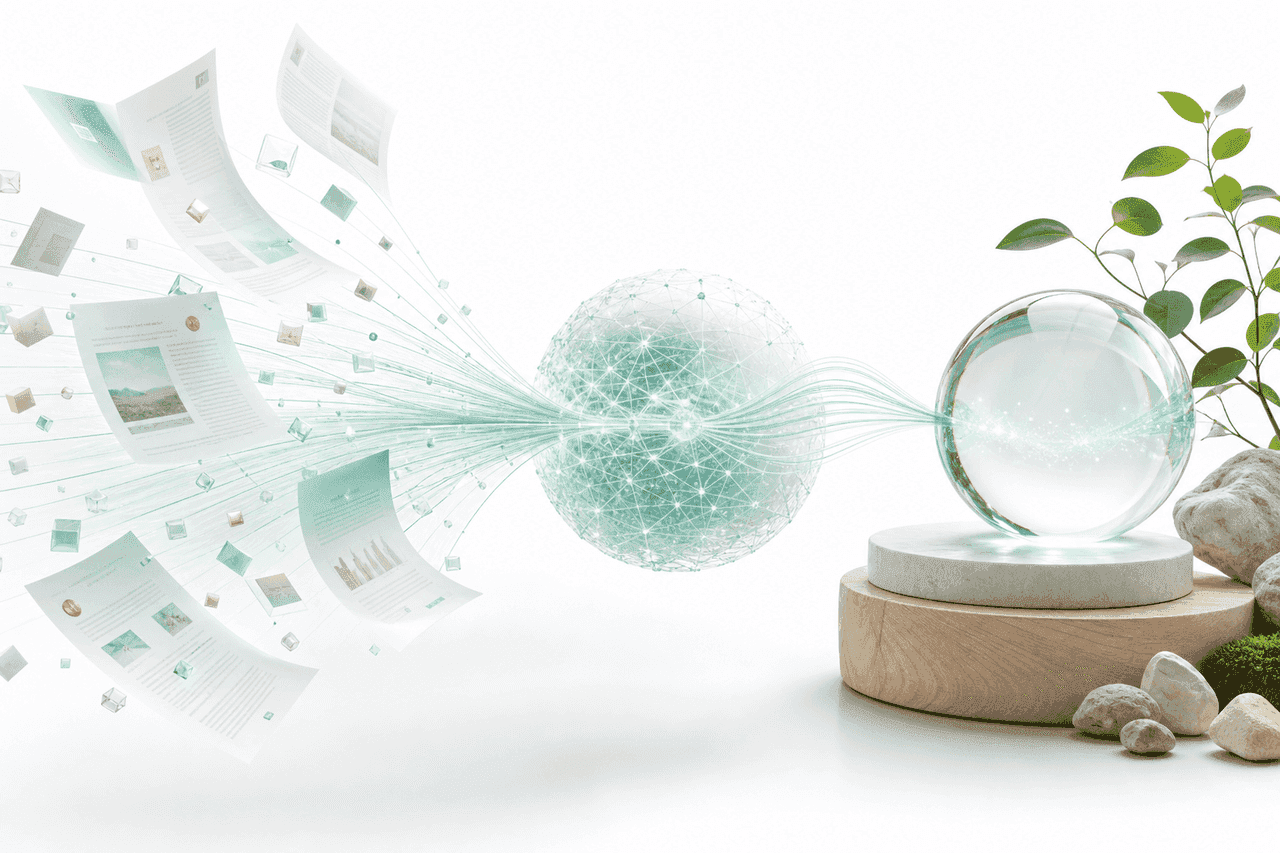
Your Enterprise Knowledge, Transformed Into Intelligent AI
Digicane Systems’ RAG technology converts your internal documentation and databases into an intelligent AI system which generates accurate and contextually relevant answers in real-time. All answers are derived from your organization’s data itself, without any conjecture.

What Is RAG and Why Does It Matter?
Why Standard AI Fails Enterprises and How RAG Fixes It
Out-of-the-box AI models such as ChatGPT learn from data present publicly on the Internet. These models lack access to the information in your internal policy documents, manuals, agreements, research works, compliance regulations, and operational guidelines.
- Moreover, conventional AI models can hallucinate while confidently producing information which is not backed by any sources whatsoever.
- Retrieval-Augmented Generation (RAG) addresses this problem.
Before responding, a RAG-based AI model searches your internal knowledge base, retrieves the most relevant pieces of information, and feeds it to the language AI model as contextual input. The AI produces responses based on your actual documents, with citation to provide complete credibility. What you get is an AI system that knows your business as well as your most knowledgeable employee.
RAG Systems We Build
Six Types of Enterprise RAG Systems
Enterprise Knowledge Assistant
A company-wide AI assistant that answers employee questions by searching across SOPs, HR policies, training materials, operational documentation, and internal knowledge bases.
Ideal For:
BFSI, Healthcare, Manufacturing, Government, Enterprise Organizations
Legal & Contract Intelligence
Upload contracts, agreements, NDAs, regulatory documents, and legal records. The system identifies clauses, compares versions, answers legal questions, and highlights compliance risks.
Benefits:
- Faster contract review
- Reduced legal workload
- Improved compliance visibility
Ideal For:
Legal Firms, Financial Services, Real Estate, Government
Product & Technical Documentation AI
Allow customers, support staff, and field engineers to raise their queries in conversational language. The technology extracts answers by searching through technical manuals, datasheets, problem-solving guidelines, and other product literature.
Ideal For:
Manufacturing, SaaS, Telecom, Hardware Companies
Government Scheme Discovery Platform
Citizens can raise their questions related to eligibility and application procedures in clear language or even in their native language. The technology will find information from thousands of official schemes’ documents.
Ideal For:
Government Agencies, NGOs, Public Service Organizations
Financial Research Assistant
Allow analysts to query annual reports, earnings transcripts, regulatory filings, market research, and investment documents without manually reviewing hundreds of PDFs.
Benefits:
- Faster analysis
- Improved research productivity
- Source-backed insights
Ideal For:
Banking, Investment Firms, PE/VC Funds, Consulting Companies
Customer Support Knowledge Base
Transform static support documentation into an intelligent self-service platform that provides instant, accurate answers while reducing ticket volume.
Ideal For:
E-Commerce, SaaS, Telecom, Healthcare Organizations
RAG Development Company Architecture
How We Build Enterprise-Grade RAG Systems
Phase 1 – Data Ingestion & Pre-processing
We ingest and preprocess the content collected from PDFs, Word files, Excel files, database entries, SharePoint repositories, web pages, APIs, and other sources. The content is processed and structured for index generation.
Phase 2 – Intelligent Chunking Strategy
Context-aware chunking ensures the preservation of document structures and relationships to improve search performance and avoid loss of context.
Phase 3 – Embedding & Vector Indexing
The content gets turned into vectors that get stored in vector-based knowledge base such as Pinecone, Qdrant, Weaviate, or pgvector based on specific requirements.
Phase 4 – Hybrid Retrieval Engine
We leverage semantic vector search and traditional BM25 keyword search techniques and rerank results to optimize for maximal accuracy and relevancy.
Phase 5 – LLM Synthesis with Citation
The retrieved content is passed to the language model following strict guidelines. Each generated answer is backed by the correct context and citations to original documents.
Phase 6 – Evaluation, Monitoring & Continuous Refresh
Answer accuracy is assessed and monitored using relevant RAG evaluation frameworks, and the knowledge base stays synchronized with your evolving content.
Core Technologies We Use
Vector Databases
- Pinecone
- Qdrant
- Weaviate
- pgvector
Large Language Models
- GPT-4o
- Claude
- Gemini
- LLaMA
- Mistral
Retrieval Technologies
- Semantic Search
- BM25 Search
- Hybrid Retrieval
- Reranking Models
Enterprise Integrations
- SharePoint
- Google Drive
- SAP
- Salesforce
- HubSpot
- Custom APIs
Security & Deployment
- On-Premise Deployment
- Private Cloud Deployment
- Role-Based Access Control
- Audit Logging
- Data Residency Controls
Frequently Asked Questions
Can the RAG system work with Indian regional languages?
Yes. We support multilingual RAG pipelines capable of handling Hindi, Tamil, Telugu, Bengali, Marathi, Gujarati, Kannada, Malayalam, Punjabi, and other regional languages.
How do you protect confidential enterprise data?
We offer fully private deployments using open-source and enterprise-grade LLMs. Your documents remain under your control and can be hosted entirely within your infrastructure.
How often should the knowledge base be updated?
We implement automated update pipelines that detect changes in source documents and refresh embeddings automatically, ensuring information remains current.
How is a RAG system different from SharePoint Search?
Traditional search tools locate documents containing keywords. RAG systems understand the intent behind a question, retrieve relevant information, and generate a precise answer with source references.
Can a RAG platform integrate with our existing systems?
Yes. We integrate with document repositories, ERPs, CRMs, ticketing systems, internal databases, cloud storage platforms, and custom enterprise applications.
What is RAG in AI?
RAG (Retrieval-Augmented Generation) is an AI approach that combines large language models with external knowledge sources to generate accurate, relevant, and context-aware responses based on real business data.
What is Retrieval-Augmented Generation (RAG)?
Retrieval-Augmented Generation (RAG) retrieves information from documents, databases, or knowledge bases before generating a response. This helps AI deliver more reliable and up-to-date answers.
How does a RAG model work?
A RAG model first retrieves relevant information from trusted data sources and then uses a large language model (LLM) to generate accurate responses based on the retrieved content.
What is a RAG pipeline?
A RAG pipeline is the complete workflow that includes data indexing, information retrieval, context generation, and AI-powered response creation. It ensures accurate and context-aware outputs.
What is the difference between RAG and LLM?
An LLM generates responses based on its training data, while RAG enhances an LLM by retrieving information from external knowledge sources before generating an answer, improving accuracy and reducing hallucinations.
Is ChatGPT a RAG model?
ChatGPT is a large language model, not a RAG model by default. However, it can be integrated with RAG systems to retrieve information from external documents and provide more accurate responses.
What are the four stages of RAG?
The four main stages of RAG are data indexing, information retrieval, context augmentation, and response generation. Together, these stages help deliver reliable and relevant AI responses.
What are the benefits of RAG Services for businesses?
RAG Services improve response accuracy, reduce AI hallucinations, provide real-time access to business knowledge, and enable employees and customers to receive reliable information instantly.
Which industries can benefit from RAG Services?
RAG is widely used in healthcare, finance, legal, retail, education, manufacturing, customer support, and enterprise knowledge management. It helps organizations make better use of their internal data.
How do I choose the right RAG solution provider?
Choose a provider with expertise in AI, vector databases, LLMs, enterprise integrations, and secure knowledge management. A trusted partner should deliver scalable, customized RAG solutions that fit your business needs.


