AI Agents Automation in India: A Complete Pricing Guide
July 18, 2026






 By
Digicane Team
By
Digicane Team
Most companies which decide to integrate chatbots with artificial intelligence face the same problem – the system sounds intelligent and eloquent, but it sometimes provides an answer which is not true, and in some cases, this answer can be quite awkward or even dangerous if acted upon by your client or employee. The reason is quite simple – language models only know what they learned during training and cannot gain any insight into your company’s policies, product information or other internal documents unless you explicitly allow it.
RAG Services are designed precisely to resolve this issue. RAG, which stands for Retrieval Augmented Generation, is the architecture which allows an AI system to retrieve actual and up-to-date information from your company’s knowledge base before answering the question instead of basing its answer solely on the pre-trained data. In this guide we will discuss what exactly RAG is, how it operates and why it became one of the most important parts of enterprise AI integration.
The regular language model is trained only once on vast amounts of general texts, and after its training, its knowledge is basically static, meaning it knows what it knew back then and nothing else since then. The language model has no knowledge of your company’s new pricing, internal HR policy from last month or even a new product update that happened yesterday because the language model was trained before all of these things happened. When the question is asked by a user outside the knowledge gained during training, a language model does not just state that it does not know about that. Instead, it generates an answer that is believable, but it is not true, which is known as “hallucination”.
While this is not necessarily a problem in case of a general chatbot, the wrong but confident answer in a business environment where AI is supposed to help customers or even make decisions can lead to serious issues. That is why there was a need to come up with something else.
Retrieval Augmented Generation is quite a technical term, but once you break it down, it is actually very straightforward. Rather than having a language model generate its response based on its internal memory alone, a RAG system goes ahead and looks for the appropriate information in your documents, policies, and knowledge base before giving that information to the language model along with the query itself.
So, in essence, what it does is gives the model the query it got and the exact information it needs to generate the appropriate response to the query. This is much more reliable compared to asking the language model to just remember from memory, and this can be thought of as the same as giving a new employee the relevant policy documents before he or she answers a query rather than asking him or her to answer a policy-related question based on his memory alone.
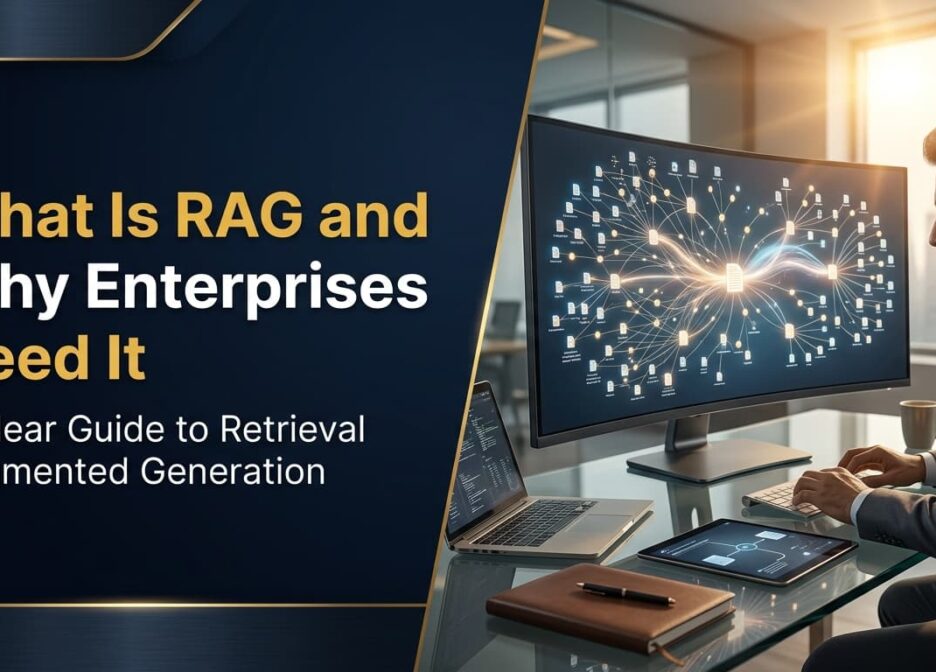
The mechanism of RAG operates according to a relatively predictable pattern in almost all instances, although the technical details behind it can become very complex. Your company’s documents, whether they are product manuals, human resources guidelines, old tickets from support service, or internal wiki, are first analyzed and divided into meaningful pieces of text. Such chunks of text are further transformed into a numeric representation that is stored in the so-called vector database, which helps the algorithm search through the data based on its meaning rather than key words.
Once there is a request for information, the algorithm retrieves from the database those pieces of information that are the most relevant to the particular question and presents only the required information instead of whole library of documents. The selected information is next concatenated with the original question and presented to the language model, which produces the response to the original question based on the actual extracted information, rather than relying solely on its own memory. Overall, the process usually takes only several seconds, so that the end-user experience is merely asking a very well-informed assistant the question and receiving the answer immediately.
Trust is the primary factor motivating the implementation of RAG technology for enterprises because a business cannot implement any sort of AI system if its output sometimes consists of outright hallucinations with complete certainty. This is where RAG steps in as a solution – every answer provided by the RAG-based AI system is grounded by the verified information, reducing the risk of errors significantly and making the system dependable in the eyes of business users. Another important factor is compliance, especially in terms of regulated sectors; with the help of RAG Services, a company implementing AI can trace exactly what source contributed to the answer provided and have an audit path available that is impossible with a generic language model.
Cost efficiency comes into play as well, because a knowledge base is updated just like the actual documents are, making it unnecessary to train the model from scratch every time something changes, saving the business both time and money. Data security is a huge issue in the process; the fact is that a company can keep all the private data inside the knowledge base and not integrate it into the language model directly.
The frequent question posed by business leaders is why not to simply employ a more advanced language model instead of building an entire retrieval system based on it. And the answer is simple – even the most advanced model at disposal only knows what it was trained on, and no matter how much intelligence you put into something, it doesn’t help you with a lack of relevant, up-to-date, and private information. With a larger model, one may present a misleading response as if it were correct, yet it won’t be any more correct if it had no access to the actual data. While the problem solved by the RAG approach differs from the problem solved with a larger model. It is a problem of access to information and not an increase in general intelligence of the machine itself. That is precisely the reason why the RAG Services and large underlying models go hand-in-hand, the former provides access to knowledge, and the latter provides means of reasoning.
The use of enterprise knowledge management is another clear example, where users will be able to query their internal documents such as policies and wiki through natural language and will receive precise answers straight out of the document. Customer support is also another area that is greatly benefited from RAG as RAG will be able to provide customers with detailed answers related to the products or policies with reference to the actual documentation. RAG is also used by legal and compliance departments to conduct searches in contracts and case files and to retrieve clauses and precedents from the thousands of pages in no time.
RAG is very prudently used in healthcare organizations in order to assist staff members by providing them with access to the clinical documentation and protocol and by making sure that all the decisions made are reviewed by a qualified professional at the end. RAG can also be used together with AI Agents Automation where an agent will be able to take actions according to the answer provided through retrieved information.
Another misconception about RAG is that it totally removes any hallucinations from the system, whereas in reality, it just reduces the probability of such occurrences to an insignificant level while at the same time being strongly dependent on the structure and quality of the documents used. The next myth is that RAG Services is needed by big businesses with huge document databases, while in reality, even a medium-sized company having its own knowledge base can gain from building a RAG system.
There is also a perception that RAG involves retraining the AI model, whereas the main advantage of the approach is exactly the independence of the knowledge database from the underlying AI model. Lastly, it is quite common to perceive RAG Services as something purely technical which should be left for the developers only, while in reality, business leaders should have at least some idea about this approach due to its influence on the performance of AI systems deployed within their organization.
The first obvious indication of readiness of a company to RAG system is the amount of internal documentation – be it policies, product information, history of customer support or processes documentation – regardless of the fact that it exists but not organized and gathered in one place. If you and your colleagues are repeatedly responding to the same repetitive questions through searching through the documentations manually or in case your current AI tools have provided your customers/employees with confident yet incorrect answers, then there’s a high chance that with the RAG system implemented you can immediately see the results.
It is always helpful to have an idea what specific use case of RAG Service is the priority at the moment – whether it’s internal knowledge base access or customer support or any other particular type of it. Companies that are already working with Vision AI Solutions or Voice AI Solutions usually get to RAG quite naturally as well.
RAG stands for Retrieval-Augmented Generation, an AI architecture that retrieves relevant information from trusted knowledge sources before generating a response. This approach improves the accuracy and relevance of AI-generated answers.
RAG significantly reduces AI hallucinations by grounding responses in retrieved information from reliable data sources. However, the quality and accuracy of the underlying knowledge base remain essential for achieving the best results.
No, RAG is beneficial for businesses of all sizes. Any organization with documents, manuals, knowledge bases, or internal data can use RAG to improve AI-powered search and customer support.
A vector database stores information based on semantic meaning rather than exact keywords. This enables RAG Services to retrieve the most relevant content quickly, even when users phrase their questions differently.
Fine-tuning modifies the AI model by retraining it on new data, while RAG keeps the model unchanged and retrieves relevant information from external sources before generating a response. This makes RAG easier to update and maintain.
Yes, RAG Services can process multiple document formats, including PDFs, Word files, spreadsheets, presentations, websites, and internal knowledge bases. This allows businesses to centralize information from various sources.
The update frequency depends on how often your business information changes. Since RAG updates the knowledge base instead of retraining the AI model, keeping information current is faster and more efficient.
Yes, RAG can be deployed with secure, private knowledge bases and controlled access to protect sensitive business information. Proper security measures and access controls help maintain data privacy and compliance.
RAG is widely used in healthcare, legal, banking, finance, education, manufacturing, customer support, and enterprise knowledge management. It helps organizations deliver accurate, context-aware information while improving operational efficiency.
The best approach is to begin with a focused use case, such as internal knowledge search or AI-powered customer support. After validating the results, the RAG solution can be expanded to additional business functions.
The concept of RAG Services has become one of the most vital in enterprise AI because, simply put, it transforms a technology that looks intelligent into something that one can trust by grounding every single answer in actual and up-to-date facts rather than speculation. From the perspective of a company considering the implementation of AI solutions, getting to know about RAG is absolutely worthwhile since this concept will make or break your choice. Digicane Systems creates RAG solutions by starting with a specific application, clearly linking company knowledge, and scaling once the performance is proven. If your organization suffers from confident mistakes preventing AI implementation, it is definitely worth discussing how RAG technology can benefit you.
July 18, 2026
July 18, 2026