AI Agents Automation in India: A Complete Pricing Guide
July 18, 2026






 By
Digicane Team
By
Digicane Team
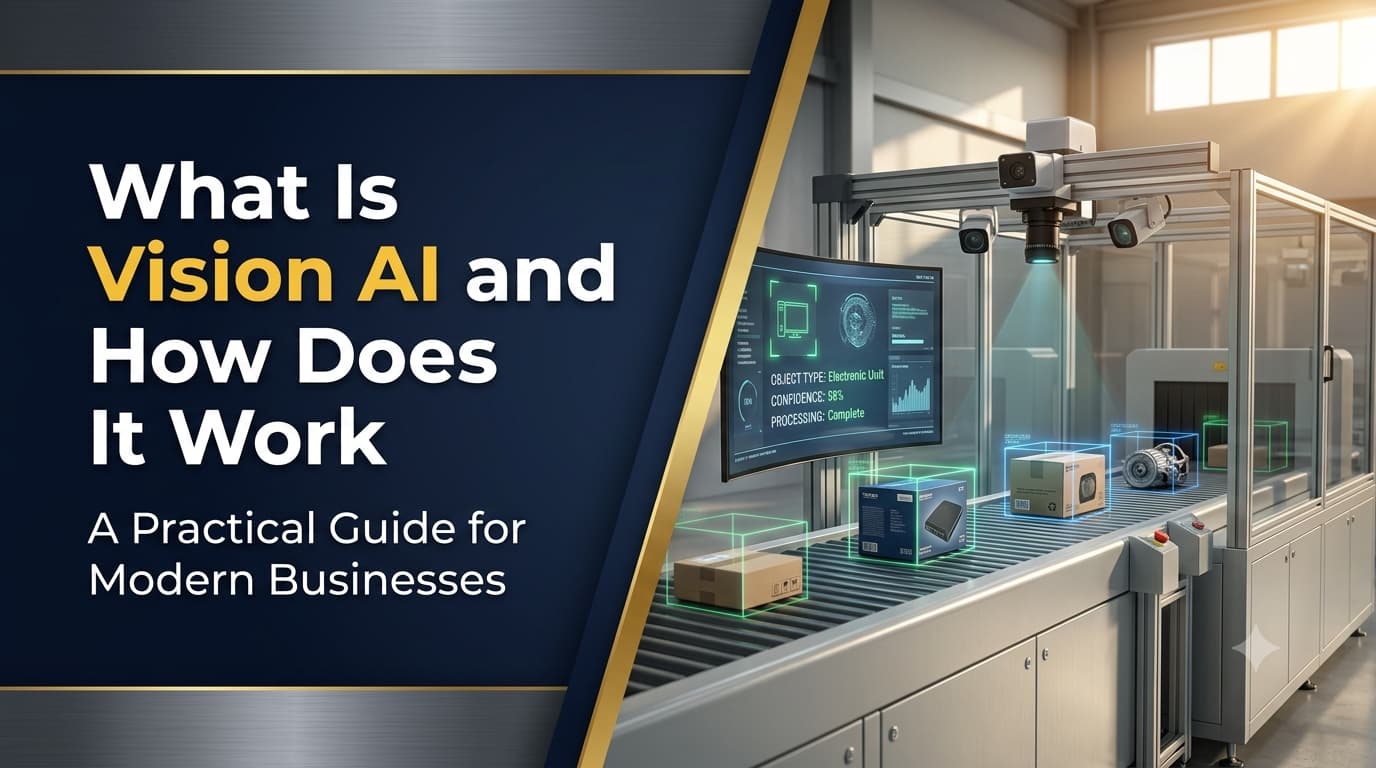
Every company produces a large number of images on a daily basis – footage from a manufacturing floor, pictures of the finished product, scanning of papers, surveillance footage from a storage room, but none of this is analyzed simply because there is nobody to actually sit and observe all of it. Vision AI Solutions are here to fill in that very gap. Basically, vision AI solutions is an ability to use a computer to analyze images and video and detect what is going on just like an experienced worker would identify defects on a manufacturing floor and see if any shelves are empty. However, vision AI does not get tired nor distracted doing its job 24/7. This guide will explain in layman terms what vision AI really is, how it works internally and what kind of applications will give a quick win to a business.
Vision AI uses two complimentary technologies – computer vision that refers to the ability to analyze visual information, and machine learning that allows one to learn from examples rather than to get precise rules for each case. It means that vision AI learns to recognize certain objects the same way as a new recruit recognizes defects in a product by watching good and defective products rather than getting precise instructions on how to distinguish them both. The main advantage of this approach is that vision AI learns from thousands of photos while a regular employee usually sees just a couple of examples. As a result, vision AI becomes really efficient and consistent after training. Moreover, such technology allows one to take a still photo or video frame or to use a live video stream to detect certain objects and defects in them. It should be noted that this is the essential difference between a camera that just captures pictures and vision AI technology that allows one to analyze them.
Typically, this process starts with data, in this case photos and videos recorded in the very location where the system is going to be implemented, as a model trained using Internet pictures would have problems dealing with the particular light, angle and objects present in your facility. This footage is labelled in order to teach the system what a good picture and a bad one look like and this is when the vast majority of the intelligence is created. After being trained, the system enters the inference period, during which it analyzes the live stream of footage and immediately makes decisions such as identifying an object as defective, counting items or recognizing a certain pattern in less than a second. Effective systems continue to learn even when they are already in use, and that is why vision AI systems tend to get even better after several months of implementation as opposed to the initial results. None of the above mentioned processes require your team to know the technical side of things, however, understanding how this all works gives you an opportunity to make reasonable questions when choosing a provider.
Vision AI’s real-world capabilities are much more extensive than many people think after learning about the technology properly. It can quickly and precisely count objects, which is important since the process of doing it manually is slow and often causes mistakes. It can identify defects in products during the manufacturing process at the consistency that cannot be achieved by a person even in an hour. Vision AI can detect whether a person is wearing all required protective equipment before entering a hazardous area, which is impossible for a person to do. It can scan and analyze the content of paper documents, converting them into data without any manual input. Moreover, it can track trends such as traffic in a certain area over time to provide more precise figures than approximate estimates made by a person. Businesses that pair vision AI with AI Agents Automation often go a step further, since the agent can act on what the vision system sees, automatically flagging an issue, updating a record, or alerting the right team member without anyone having to connect the dots manually.
The manufacturing industry has been an early adopter of this technology because visual quality control is one of those repetitive, tedious tasks that can be automated through the use of vision artificial intelligence. Vision AI is extensively used in the warehousing and logistics industry in stocktaking, where machines will help to reduce errors caused by humans who rush through the task. The retail industry uses vision artificial intelligence in shelf management, which monitors the stock in shelves and detects any missing items before the customers spot them. In the healthcare industry, vision AI helps in diagnostic imaging by assisting medical experts to make their reviews quicker but still retaining the decision-making process to a human being. In security and facility management, vision AI helps the personnel to track activities in facilities without having to physically monitor each and every video feed continuously.
It is helpful to recognize the distinction, because companies often believe that their bases are covered since they have security cameras in place. The problem with a typical camera is that it just films, but then the footage must be watched or reviewed by somebody at a later time, when it is quite possible that some important things may have been overlooked due to lack of attention at the time of filming. Manual verification, regardless if it is carried out by a quality control employee or by a team carrying out stocktaking, is definitely useful, but it is subject to the constraints of human limitations like fatigue and changing shifts. Vision AI does not take the place of your employees’ judgement, it frees them from the need of watching things all the time so that they can concentrate on things that really require a human eye.
The first and foremost problem that arises is data privacy, and it is a valid point, particularly where cameras are concerned, thus a reputable supplier will provide you with information about storage of footage, who can view it and for how long. The issue of accuracy is the second popular one, but here is what you should know right away – no vision AI system starts out with impeccable accuracy. Accuracy grows over time due to the increase of real-world examples that it processes, which is why a short pilot phase before implementation is almost always a better idea. Another common problem is integration, as businesses tend to believe that vision AI implies replacement of the entire camera network. In the vast majority of cases, however, it works fine with your current setup and causes no expenses and trouble you might expect. Finally, cost is also an issue. It is important to understand, though, that it is rather an investment than an expense, taking into account that even a single saved safety event or decreased error rate makes it completely worthwhile.
An obvious place to start would be to consider a process that involves a need for somebody to constantly observe, monitor and check something during working hours as these processes tend to become the prime candidates for the very first implementation of vision AI technology. When your staff spends actual working hours monitoring the process manually and you can see tangible benefits and results from this kind of work, then the return on your investment will come rather quickly and easily measurable. Of course, some cameras or an installation of them at the needed places should be available as the vision AI requires constant stream of images. Companies that are already using our RAG Services or Voice AI Solutions in other parts of their operations tend to be more likely to implement vision AI technology due to the fact that their teams are used to working alongside such technologies. The most accurate way to check it – conducting a short pilot on a particular process.
Computer Vision is the broader field that enables machines to interpret visual data, while Vision AI refers to practical business applications that combine computer vision with artificial intelligence to automate visual tasks and decision-making.
Yes, in most cases Vision AI solutions can integrate with your existing camera infrastructure. This allows businesses to leverage their current hardware without requiring a complete replacement.
Vision AI can achieve accuracy comparable to or even higher than human inspectors for repetitive visual tasks. It also maintains consistent performance without fatigue, making it ideal for continuous monitoring.
No, Vision AI is valuable for businesses of all sizes. Small and medium-sized companies use it for inventory management, quality inspection, security monitoring, retail analytics, and operational efficiency.
The deployment timeline depends on the project’s complexity and business requirements. Many organizations begin with a pilot implementation before expanding the solution across multiple operations.
Yes, modern Vision AI systems are designed to analyze live video streams in real time. This enables instant object detection, activity monitoring, quality inspection, and safety alerts.
Vision AI is widely adopted in manufacturing, healthcare, logistics, retail, warehousing, agriculture, automotive, and security. It helps organizations improve efficiency, accuracy, and decision-making.
No, Vision AI is designed to assist employees rather than replace them. It automates repetitive visual tasks, allowing teams to focus on complex decisions and higher-value responsibilities.
Reliable Vision AI solutions include secure data storage, controlled access, encryption, and compliance with applicable data protection standards. Privacy and security should always be considered during implementation.
Choose a company with expertise in computer vision, AI model development, system integration, and industry-specific solutions. A trusted provider should also offer pilot testing, ongoing support, and scalable deployment strategies.
Vision AI technology is no longer a futuristic technology but a reality that transforms the mundane tasks such as observing, counting, and inspection into consistent, rapid processes. The companies which derive better benefits from the implementation of vision AI systems are the ones that do not attempt automation of everything at once, but begin with a single process and then gradually grow after achieving success in the first process. Digicane Systems develops vision AI systems following the similar approach, beginning with a pilot project on your most impactful process. This way, you will be able to derive some benefits from vision AI even prior to investing a substantial amount of money in its large-scale implementation. Whenever there is any task in your workflow involving constant observation, counting, or inspection, it would be reasonable to discuss how vision AI may help you with it.
July 18, 2026
July 18, 2026